Wednesday, August 20, 2014

"Von wem haben sie gelernt?" From whom have you learned?

"….Molosser Magazin(e) which first appeared in 1981, was the provocative and courageous brainchild of Christofer Habig, an internationally renowned judge, who specializes in the Molosser breeds.  Dedicated to promoting the documented history of the molosser breeds, MM went above and beyond the ordinary aspirations of most publications.  It was relentless…..in its presentation of historical documentation; relentless in promoting ethical breeding; relentless in speaking out against abuses, even when it represented political suicide to do so; in short, MM was a publication unquestionably dedicated to the preservation and welfare of the molosser breeds…."
                                    

                                            ---- Oft quoted description found on the Internet of 
                                                             Christofer Habig's now defunct but famous 
                                                                                Molosser Magazin, by Kim Slater


When one reflects upon their life, one usually can look back and name a certain person or persons who played key roles in shaping their beliefs, values, ethics and standards, which perhaps played a strong role in who they eventually became as a person.

In my life, I've been graced to have several people who served as mentors or role models to me in different phases of my life.

Fresh out of High School and kicking around a Southern California Junior College studying Geology, my passion was road racing bicycles European style - replete with my 'starter' bike, a bright red French Peugot, then graduating to a very pricy black, full Campagnolo Super Record decked out Italian hand made Colnago - one fellow racer and trainer stood out as a mentor to me: Jim Meyers, then a Senior, former Olympic team cyclist member - inspired me to reach for unthinkable goals.  A rank novice, I went on to place sixth in a California state road race, and second in some big criteriums against more seasoned racers than I.  I received an invite to the Colorado Olympic training center where the then famous and legendary "Eddy B." coached the US team.   Had I not suffered a broken left arm in a horrendous crash, then racing against Connie Carpenter, who went on to win the first Women's Olympic Cycling event in Los Angeles, no telling where I could have ended up in that pursuit.

Not long afterwards, my life found me earning a living off the backs of horses, not bicycles, as I bounced around the West hard scrabbling jobs on ranches big and small.  Under the unforgiving, tough yet compassionate and true guidance of cattle ranching legend Tom Marvel and his family of Battle Mountain, Nevada, in the final halcyon days of their huge ranching empire, I earned my stripes riding 50 mile circles on the desert rounding up cattle, getting bucked off of colts and broncs, and learning the true meaning of independence, integrity and hard work's pay offs.  I paid dangerous, harsh, hard dues.  I suffered no fools, took no prisoners, gave little damn of what people thought of me (traits I carry on to this day), and usually pushed myself beyond reason.  I respected reason, knowledge and experience when I saw it, and expected respect in return.

During the better part of the 1980's when I was ranching, I also raised working cattle dogs - mostly the then rare Catahoula Leopard Dog.  I wrote an article about them in the June 1987 issue of Dog World.


Sometime during this period, I became aware of a magazine out of Germany called Molosser Magazin.  I ordered my first copy from Germany; it was expensive, and came painstakingly slow.  Once I had my hands on it, however, I knew I had stumbled upon the Holy Grail of all that was Dog Related.  I could not put it down, and ordered more back issues - my biggest regret is that I never ordered all the back issues.  I read what I had, again and again.


The editor and publisher, Christofer Habig, was at the time a Political Science professor at the University of Duisberg, Germany, and this magazine was his personal hobby and passion.  He was, indeed, as cited in the quote at the beginning of this blog post, relentless in his pursuit of honesty, transparency and integrity in breeding Molosser breeds.  I became convinced I had to know this man, and more than that, perhaps even meet him in person.

The opportunity soon conveniently arose, as if on predestined cue.  Not content to merely read his resounding articles and editorials in MM, I wrote him directly.  It so happened he was coming to the US in June of 1987 to judge the second American IMF Supermatch in New Jersey!  I flew back there for the show, no small feat for me at the time.  We met, albeit briefly, in the sweltering heat of a Newark summer.  He asked me to contribute to MM by writing an article on Catahoulas; I was beside myself with the offer and of course, obliged.


For months following this we exchanged many many letters, discussing everything from dogs to philosophy to the meaning of life…..his brilliance, worldly knowledge and relentless dedication to integrity in all things dogs, captivated and motivated me.  But later that year, he ended his great magazine endeavor to 'take a break' and married (a very lucky) Austrian woman and started a family.  He later became Vice President of the FCI and the head of Deutsche Bank.  No small potatoes there.
He still judges now and then when his schedule permits.

I can only look back and realize how lucky I was to have met him and known Habig.  He taught me so much.  He taught me not to compromise in terms of ethics and principle.  To always push for the truth, for integrity, quality and honesty.  

To that end I too, have committed what one could call "political suicide" in the LGD world.  I've been booted off and kicked out of just about every Livestock Guardian Dog and Spanish Mastiff online forum that exists; I have the unnerving tendency to speak the truth no matter who it may offend; to question the questionable and not sit back and remain mum and be, as we Americans refer to as, "Politically Correct".  I am not afraid to call fakirs out on the carpet, or point fingers at puppy mills and unethical breeders.  I take a stand and stick to it.  I also can admit when I make a mistake - something few self crowned "LGD experts" seem to be willing to do.  

Where most people cower and shake, I on the other hand, have turned into the Dirty Harry of the LGD world. Packing verbal .44's,  in just five years, I have earned a reputation for being steely of eye, firm of handshake, and no taker of prisoners or sufferer of fools, arrogant cads or shifty people who are most at home in a gutter or the shadows in the dog world.  People either love me or hate me.  There is rarely anyone sitting on the fence.

But I realize my fortune in choosing a man of Habig's stature and ethics to be my mentor.  It has not always been an easy road to follow, but I can sleep at night.

I learned from Christofer Habig.  From whom have you learned?


From his 2/86 Molosser Magazin issue, a few lines from his editorial titled "Von web haven sie gelearnt?"

"Molossers……are a very special and difficult subject because, due to a stormy history, there are great variations of type in all our breeds….What we need to do, therefore, in order to participate in the well-being of our dogs, is to learn to recognize quality…..in order to recognize quality, you need a trained eye." 

(You may remark or realize what he says here has also been said on this blog previously in my post called Transparency and my post on Mediocrity.  If you have not read those posts yet, read them now.)

Habig continues:

"….In an ideal world a two-way communication would have already been set up between those who are keen and anxious to learn and those who have knowledge and information to impart.  Alas, Utopia is still a long way off, because, on the one hand, very few people really bother to seek knowledge or widen their perspectives, while, on the other hand, not all those who have the knowledge are will ing to share it, and some even jealously guard their precious and hard-won knowledge like some alchemist's secret stone.  It seems to me that this problem is to be found in the world-wide scene of Molosser breeding, no matter to which of our breeds nor to which country one refers."

Truer words never spoken - and thus spoken in 1986, and still, true today!  In the LGD world in particular, and in America, the Spanish Mastiff 'crowd' - no truer, cutting words could be applied.  How many of you have sat endlessly on LGD online forums tiring of the same braggarts with little experience who's mission in life seems to be to lord it over those who know less or who might challenge their precious corner of expertise (assuming you can even refer to it as such)?  

Habig goes on, and closes with "….There are, indeed, many roads to Heaven - it doesn't matter which one you choose but at least get started!  Look for qualified teachers in Molossers and train your eye!"

So….who are you learning from about Spanish Mastiffs and other LGD breeds?  Braggarts?  Johnny come latelys with no real experience or field knowledge, who have learned everything they know out of books or Internet sources?  Pompous know it alls?  Mercenaries cashing in for a quick dollar off the fad of LGDs?  Inhumane puppy millers, show ribbon collectors and fakes?  Careless stockmen who won't handle, feed or care for the LGDs they use like castaway tools?  

Or are you listening and learning from honest people with honest, real world credentials, who truly love their dogs, strive for a deeper understanding of them, treat them with respect and compassion that they deserve, and who refuse to sell out their principles and ethics?

It is a choice only you can make.  

A bad teacher will produce a bad student.  Just ask Mr. Miyagi.


Thursday, July 10, 2014

Abelgas


These are what true, real working Spanish Mastiffs look like, on the job in Spain.  

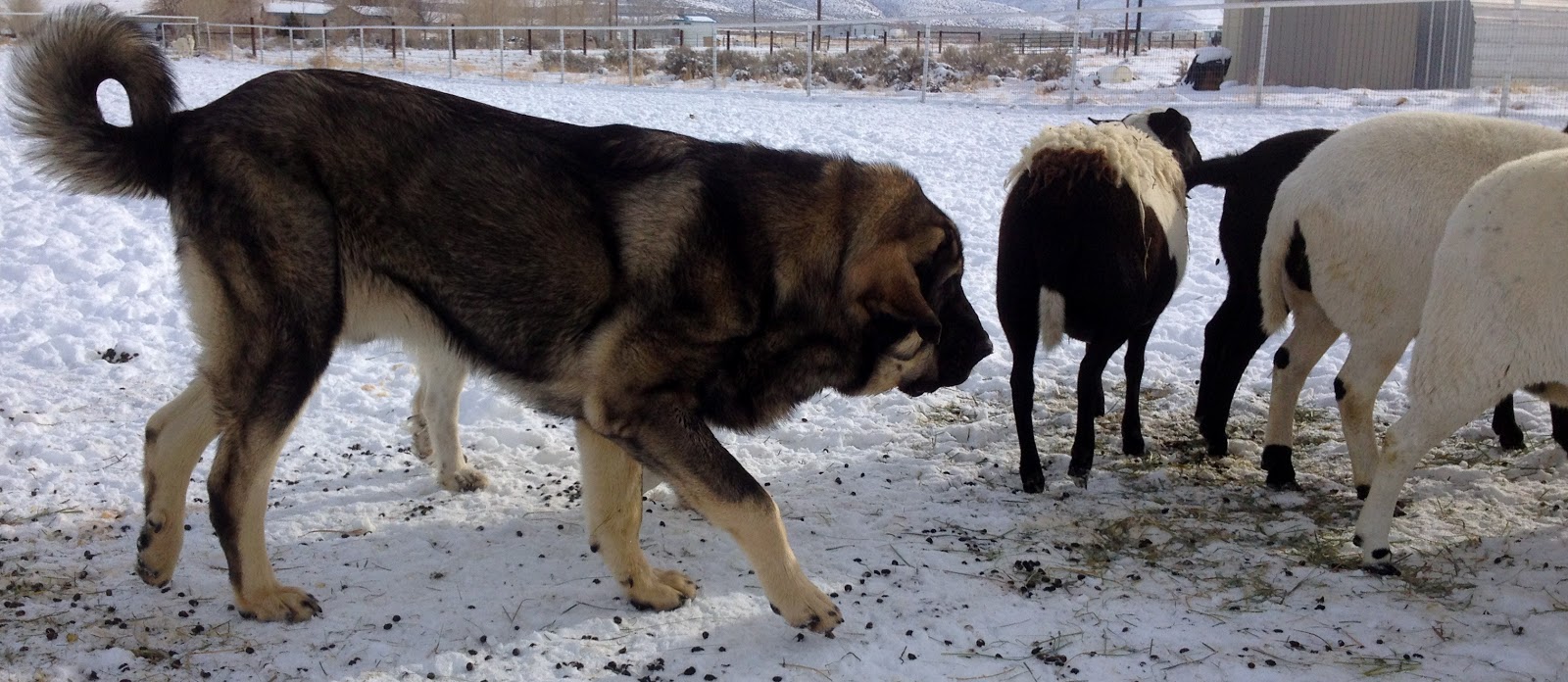
Below, Spanish Mastiffs of Gregorio Fidalgo Tejedor of Mastines de Abelgas, with their sheep in Spain.  The 'bob tailed' SM often shows up in a litter, and is a throwback.  The dark male in the lead is Guido, sire of one of my Abelgas females that I imported here.


I'm proud to be the only person in the USA Abelgas is working with and has exported dogs to.  I am excited to announce that in order to maintain the best bloodlines here, and expand my breeding choices, more Spanish Mastiffs will be coming from Abelgas to my ranch from Spain later this year.  

The two litters I have out of my Abelgas girls at the ranch now sold out immediately as the word has spread about just how incomparable these dogs are as guardians.  Crossed with my non-Abelgas Spanish Mastiffs, the litters still retain exceptional guarding, nurturing abilities and intelligence.  And because my SM are uniquely pack raised, they come out of here far more advanced than other LGDs who are not raised this way.

More photos of Abelgas dogs on the job are below.  


Sunday, May 4, 2014

Learn to Discern Quality and Health in REAL Working Spanish Mastiffs

Like anything else in the world, there is both good and bad out there in Spanish Mastiffs.  There are people trying to pass dogs off as Spanish Mastiffs who are not Spanish Mastiffs.  

Learn to tell the difference.  

If you don't you have no one to blame but yourself.

What follows below are several photos of REAL Spanish Mastiff dogs and puppies I have bred here from my imported stock from Spain and the Czech Republic, and imports.  

These are what healthy, robust REAL working Spanish Mastiffs look like.  Good flesh, muscle tone, vigorous, alert, intelligent expressions with depth and knowing - a 'wisdom of the ages' look.  

It is hoped by looking at what real working SM look like on this blog, that it will assist readers in telling the good from the bad.  There seems to be a whole crop of neophytes out there who are easily misled down primrose planted paths by lesser and unscrupulous dog breeders.  Don't be one of them. Educate yourself.

Unfortunately there are too many unhealthy, inferior Spanish Mastiffs being bred in America.  Some are undersized, lacking type and bone, and sickly.  Some are sub-standard specimens from puppy mills and others are pseudo working dogs being bred for conformation and AKC acceptance, not work ethic.  As this increases, there is great concern that the working instinct of this breed will be snuffed out by conformation focused breeders.  That is what I fight hardest against.

Learn to tell the difference between mediocrity and excellence.   LOOK at what you are looking at.  Stop allowing people to pablum feed you a bunch of bunk.  ASK questions.  If they say that dog is "half Spanish Mastiff" they had darned well better be coughing up photos of the Spanish Mastiff half.  If they don't, run in the opposite direction.  

There are a few LGD breeders out there now trying to pull this one off a lot because SM's have become popular.  Of course they don't really OWN a REAL SM themselves, so they concoct an invisible Spanish Mastiff 'sire' floating around out there someplace in the wilds of Montana.  It wouldn't be bad if they'd just confess the pups they are peddling are probably only 1/8th SM but no, they usually try to make them out to be more than they really are.  And what they look like is never anything close to the photos below.

Don't be duped by unscrupulous dog breeders trying to make silk purses out of sow's ears. 

The bottom line is: YOU need to expect and demand honesty from a Spanish Mastiff breeder and top quality in their dogs; if you don't, the only person you can blame is yourself.  

If YOU settle for mediocrity, and don't care if an unscrupulous breeder is lying through their teeth to you, well, what does that tell me about you?  

A lot, unfortunately…..


~~~~~~~~

Below:  Like father, like sons.  Double Abelgas bred pups Gus and Clyde (named Chili Verde and Cinco from my "C" Litter) and Oso (named Coso) out of Furiano de Puerto Canencia and Tioda de Abelgas.


Below, Agostin and Argenta, Furiano pups out of Zaca Tornado Erben.
Depth, soul, nobility and intelligence.  These attributes are what this ancient noble breed should always possess.  Good specimens of Spanish Mastiffs show this.  Argenta, below.
Various photos of my Abelgas bitches Loba (Crisa) and Tioda, taken when younger and recently.


 Below:  Tioda (LaReina) de Abelgas, the Sphinx….
 Furiano in his sheep.
Agostin, below, showing tremendous strength, size and a most intense and devoted guarding instinct.  Another son of Furiano and Zaca.
Below, again, like father….like son.  Xanto Tornado Erben, solid muscle and power, and his son out of Loba, Beau Beau the day he turned 8 weeks old.  Note size of his feet.


Below, more pups I raised here, getting time in their sheep and heifers, and some of my Spanish Mastiffs.


Friday, December 13, 2013

Cattle and Spanish Mastiffs: A Natural Combination When Done Right

The working Spanish Mastiff is used heavily in its native country of Spain to guard not only sheep, but cattle as well.   Selling the idea of using LGD's to protect cattle in the USA with larger cattle producers has often been a tough sell, however, these dogs can and will guard cattle if raised right.  The failure, if any, is usually on the part of the owner/operator, or in the way the breeder reared the pups up.

Spanish Mastiff pups in their heifers with adult dogs near by.
I happen to think the relaxed and more low key demeanor of the SM and also,
the Pyrenean Mastiff, makes these two breeds
superior choices for guarding cattle.

As with any LGD breed, and not just the SM, what matters is that the pup comes from proven, good working parent stock, and is raised from birth in a livestock environment.  Being raised up in a pack of LGDs makes for even more advanced, capable pups than those who are not.

The transition here at my ranch, from sheep to cattle, has been seamless and quick.  My heifers are not afraid of my dogs and welcome the pups into their area, curious but non-threatened, and the pups likewise, quickly realize cow time is good times…..and they are settling in fast.  The size of cattle always demands more respect from any LGD, and pups find out quick if they nip or act up, the heifers will reprimand them strongly.

Placid scene: Spanish Mastiffs bed down near their cattle, on guard.
Ready to defend, there is no constant fence running and barking or un-needed
activity, as other lighter, more hyper LGD breeds would exhibit.
Calm dogs = calm cattle.  Win/win for both, and the rancher.
In a larger operation covering more ground, combining Spanish Mastiffs with some lighter, faster breeds such as Kangal or Akbash, would be good choice for 
perimeter patrolling and enhanced coverage.

Pups coming out of pet stock that has no exposure to cattle, goats or sheep, cannot be expected to pick this up as fast, if even at all in some cases.  Therefore, its crucial for anyone looking for  true, working Spanish Mastiff pup, to get one from real working stock, not pseudo farm 'pets' or show ring conformation breeders.  Unfortunately in America, the gentrification of the SM has already begun and is in full swing, with backyard breeders now churning out litters of SM, who are not raised on stock, or around livestock at all, yet being mis-hyped by nefarious breeders as "working LGD pups".  Likewise, these pups go on to be mediocre if not poor LGD's, through no fault of their own, but due to that of unscrupulous breeders and puppy mills.  And worse yet, now those pups are having pups.  The cycle of degradation will only continue as the breed is gentrified and the working instinct bred out of it by slap dash pet breeders and puppy mills.

At 8 weeks of age, my "C" Litter of Spanish Mastiffs are now headed to their new homes over the next several weeks, some staying here through into January.  We've had an exceptionally harsh winter of 26 below temps and -41 wind chill factors.  Through out this, my pups have been raised in the barn with heat lamps, and out on the ice and in the cold and snow daily, and in and out of the sheep all day long.

On their 8 week old birthday, when let out of the barn, they surprised but did not entirely shock me by heading directly to my heifers, and asking to go into them…..

This comes from their supportive rearing here, where unlike some LGD breeders, nothing is ever forced or rushed, and the Pack leads the way for the pup's learning experiences.

I am not a fan of penning pups up with sheep and making them live with them 24/7 for days on end if not weeks, in what I refer to as 'forced bonding'.  It is a popular training and bonding exercise used by many in the US, and was promoted by the first LGD researchers as being the 'best way' to get pups to bond to stock.   I'm not saying it won't work, but I don't like it for several reasons.

First of all, I find it extremely limiting.  It prevents the pups from experiencing other things they need to experience in order to grow up into a well balanced, courageous, confident dog.  They may be bonded to sheep alright, but they are also sometimes scared out of their wits by loud noises, other dogs, and sometimes even people.  I don't consider this intelligent rearing of LGD's; to me, it is more of a shortcut for the owner.  The pup is narrow focused and has much less depth than a pup allowed to roam about, be in and out of stock as it wants in puppyhood, and getting enough exercise to blow off steam and playfulness that otherwise would be taken out on the stock.

Secondly, my way takes longer but plants more seeds of bonding and confidence in the end.  I have had enough customers tell me by now they swear my pups are more advanced than others they have bought who have been reared up in a 'forced bonding' situation.  But of course they'd be this way, not having been held back.

Finally, I prefer to let the litter's dam and sire and the Pack, dictate to me when the pups are ready, and when they are, I always know it by the supportive role the other dogs take in the pup's progressive steps.  I feel this way is more natural.  I feel this way, the dog tells me when it is ready, not the other way around.  This is not about making things convenient for me.  It is about letting the dog show me when it is comfortable and ready to take the next step.

Raising dogs this way takes more time and patience to achieve the end results but I have found it is more than worthwhile doing it this way.  And now as my pups progress to cattle from sheep, and show such excitement at meeting them, it only further confirms that their way is indeed, the smart way.

I can't speak for any others in the USA, but I sure know MY Spanish Mastiff pups can leave here to guard sheep, cattle and goats, one as well as the other.  They will be healthy, of sound mind and body, keen and sharp and courageous, and like I tell them all when they leave here, they'll grow up to be "Straight and Strong and True".


Saturday, November 23, 2013

The Numbers Game: Guardian Dog Pack Size Affects Success

The Numbers Game: Guardian Dog Pack Size Affects Success 


by Brenda M. Negri

Published in Sheep! Magazine
May/June 2013 pg 50

Copyright 2013 Brenda M. Negri and Sheep! Magazine
All rights reserved, no reproduction without express permission


When it comes to efficient predator control and livestock protection using LGD’s, real success usually comes from running the right number of Livestock Guardian Dogs for each situation. And sometimes its what you can’t see that indicates your livestock guardian dogs are working, and you are running them in the right numbers.

Kangal breeder Ed Bernell of Laurel, Montana, had filled his deer tags for the season when the call came from Montana Fish and Game asking how his hunting luck had run. Bernell gave them the required information and they chatted about hunting season.

And then came the question Ed wasn’t prepared to hear.

“Did you spot any sign of or did you see any wolves, during your hunt?” the agent asked.

Bernell recalls that he was taken aback by the question, then chuckled, and confidently replied “Of course not! There are no wolves around my area.”

He wasn’t prepared to hear what came next.

“Oh yes there are....” was the official’s blunt reply.

The official went on to report that not one, but several wolves had been sighted only four miles from Bernell’s 100 acre goat and sheep ranch situated on a high plateau, surrounded by large tracts of open land. Ranchers were reporting several wolves traveling through their ranches, wolf track sightings were increasing, and there was no doubt the wolves had now come over from the Yellowstone area and were moving in.

Bernell was perplexed. “I’ve never seen any!” was his reply to the official.

“But I do raise livestock guardian dogs. I have several here, mostly Kangals.”

“Then that may be why you haven’t seen or had any wolves in your area,” the official replied.

Bernell went on to share that this phone call caused him to re-think his strategy of running LGD’s. Prior to this, his main concern had always been coyotes and smaller predators. Faced with wolf packs however, Ed has since decided up his numbers of LGD’s that he runs, thus increasing his protection over his goat herd.

“I also try to get across to potential customers how important it is to run the right number of dogs to fend off wolves. People seem to think one or two LGD’s can do the trick. That is wrong. You must fight fire with fire.....and running more than just one or two LGD’s also increases the chances of your dogs surviving a wolf attack. It protects your LGD’s and your livestock.”

Running the appropriate number of guardian dogs will differ from one situation to the next. Factors that need to be considered include, but are not limited to:

Terrain
Brush or tree cover
Line of sight
Size of area
Number of livestock
Predator load
Predator types
Stockman’s presence or lack of
Fencing or lack of fencing
Age, experience, health and types of LGD’s
Other non-lethal means used in addition to LGD’s

Wolf packs can range from as little as three to as many as twenty - or more. For most ranchers, running twenty LGD’s is fiscally not possible. However, many report success in repelling wolf attacks from cattle, sheep or goats using as small a pack as four to six dogs. One Canadian client of mine runs around eight to ten dogs in country that carries a heavy predator load, and reports no losses since turning to running LGD’s in a pack - along with the regular use of protective spike collars.

In most successful LGD pack situations there is a combination of breeds used, incorporating both perimeter patrolling dogs and those that prefer to lie in and stay closer to the stock.

My personal experience is that there does not exist a single LGD breed out there that can accomplish it all, or is the ‘ultimate answer’ when it comes to wolf predation, and that is why I breed and run a mixture of LGD breeds, from heavy, slower, powerful Spanish and Pyrenean Mastiffs to the swifter Kangal and Anatolian/Maremma crosses. I feel that each breed has something special to bring to the table, and if raised together from puppyhood in a pack, many breeds together can combine forces to be able to make most predators think twice on picking on their livestock.

The ultimate goal is to dissuade the wolves from choosing an ‘easy meal’, and ultimately, making them go elsewhere to hunt. Ideally, there is little if any confrontation between the two thus saving the rancher the heartache of injured or killed LGD’s, and serving the conservationist’s goal of preserving the predators and not resorting to lethal measures.

Running LGD’s in a large pack is an art, and part science tempered with some luck. Not all dogs work or meld well in a pack situation. And, if they were not raised amongst a pack of dogs as pups, it can take some time to transition a pup or young dog into a pack hierarchy.

As someone who breeds LGD’s full time and runs an adult and adolescent pack of twenty to twenty two dogs at any given time, not including litters, I can vouch for the amount of work it takes and dedication on the part of the owner. The rancher or farmer must be extremely confident in their dog handling abilities or they won’t last long in this endeavor. Those not comfortable around very large or giant LGD breeds with a reputation for thinking on their own, will probably not succeed, or at best, have limited success running a large pack of LGD’s, and would perhaps be better off trying to incorporate other non-lethal means into their retinue of protection options for their livestock.

Successes are out there. Ed Bernell in Montana is one such case; also in Montana a cattle rancher reports great success using four Komodor/Akbash cross LGD’s who live with the cattle full time; the Lockhart Ranch of Debden, Saskatchewan is another using a large pack of LGD’s to protect sheep and cattle; since I began running LGDs in a large pack here the coyotes and lion have stayed clear of the area surrounding my ranch, and my dogs have killed stray dogs attempting to attack either my livestock or my neighbor’s.

In a recent Farm Show Magazine article contributing editor Jim Ruen did a small write up on my dogs called “Pack Raised Dogs Fight Harder”. Indeed, I have noticed that pups coming up through the ranks of a large dog pack are by nature, exposed to more conflict and play fighting than they would otherwise. From puppyhood, they learn how to tackle one another and defend themselves, as they’d need to as adults if attacked by feral dogs, wolves or lion. I liken this to the ‘school of hard knocks’ you often hear people refer to, and just like with people, what doesn’t kill you, makes you stronger.

In that regard, I note many of my clients tell me time and again, my pack raised pups seem to be more savvy, confident and capable at earlier ages than pups they have bought from non-pack raised environments, and again, I attribute this not so much to my upbringing, but to the lessons the pup has learned from my large pack.

Repelling predators is more than just picking the right color or breed of LGD; much more. More often with LGD’s its a numbers game, combined with the use of other strategies of non-lethal measures, and as always, participation and willingness to think out of the box on the part of the stockman.

Three "Old World" LGD breeds that can help amp up your non-lethal predator control include:


The Kangal: Swift, intense, primitive, intelligent and capable of covering a lot of territory, this ancient Turkish breed is an excellent choice for experienced LGD handlers in big predator country. Their courage in confrontations with predators is legendary, as is their endurance and strength.

Spanish Mastiffs: Native to Spain, the heavyweights of the LGD world have enormous strength and power; although slower than lighter breeds, they stay close to their livestock and are extremely formidable in a fight. A complex breed, they are somewhat aloof, steady and trustworthy with their owner but usually highly suspicious of strangers.

Pyrenean Mastiffs: Another Spanish breed, related to but larger than its French relative, the Great Pyrenees, this docile appearing giant has tremendous courage, tenacity and a fierce protective instinct, and is extremely intelligent. They are very people-friendly as a whole and make a great LGD for smaller family farmsteads with more human presence.

Sunday, November 10, 2013

The First Double Bred Abelgas Litter born in the USA

My "C" Litter of Spanish Mastiffs was born October 17th.  The pups are now just a tad over three weeks of age and in the barn between my hen house and the sheep.


Furiano de Puerto Canencia (Baruc de Puerto Canencia x Yeza de Abelgas) x Tioda de Abelgas 

Out of 13 pups, 10 have made it (one stillborn, one faded at one week and mama accidentally laid on one).   They are active, keen and advanced for their young ages.  Their straw bedding is interlaced with tufts of sheep wool so they are used to the smell of the sheep.  They will be getting their first exposure and introduction to the sheep this coming week, and the chickens as well.

For true, purebred working Spanish Mastiff bloodlines, I don't think it can get much better than this.  Both Furiano and "LaReina" are outstanding guardians, calm, never overly aggressive, tough and serious.   Furiano, a staggering 36" tall, is a popular dog with all of my guests.  He is affectionate with children and of steady mind and sound body.  Although both dogs have plenty of loose skin, they are both fit and well proportioned and travel well with ease.  They both possess classically beautiful heads and profiles.

And both parents, although not hip tested yet (their official OFA testing is on my bucket list for 2014) they both come from multi-generations of HD free rated brood stock.

I am proud to say that Abelgas Kennel breeder Gregorio Fidalgo Tejdor in Spain is very pleased with the great looks of this promising litter.

Below, daddy checks in on his pups.


Sunday, September 22, 2013

My Third Spanish Mastiff Litter is Due in Mid October


Furiano de Puerto Canencia (Baruc de Puerto Canencia x Yeza de Abelgas) has been successfully bred to Tioda de Abelgas for a mid October Litter "C".  These should be amazing pups!

Search This Blog

Popular Posts!