Saturday, November 12, 2016

Livestock Guardian Dogs are Pack Oriented, Not Solo Operators


Livestock Guardian Dogs 
are Pack Oriented 
- Not Solo Operators
Brenda M. Negri
Copyright 2016
I'm re-posting a note I put up on my kennel/ranch Facebook page, which now has over 10,000 followers, sharing insightful comments and observations from a man who contacted me about what he is seeing out there in LGDs and what their owners are - and most sadly are not - doing:
This past week I was contacted by a man who had read an article I wrote nearly 40 years ago for a national magazine (Dog World) about Catahoula Leopard Dogs - a colorful working breed from Louisiana, that is renowned for it’s stamina and herding instinct as a cow dog and a hunting dog for wild pigs. It seems my article so influenced him that he went on to buy and raise and use Catahoulas for 18 years:
“Hello Brenda. I wanted to thank you for such an informative, honest and helpful Website. You actually influenced me many years ago- you wrote an excellent article on Catahoula Leopard Dogs. That article cemented my interest, and I worked, owned, and hunted with Catahoulas for 18 years. After living and working all over U.S., I'm going to settle and have a little place. I have to decide on Oregon, ( currently live here) Texas, or Appalachia North Carolina. and I'm not looking for a pup now, doing my homework. I had 3 dogs, one recently died at 14. However, I know when I get my place I will want 2 or 3 dogs to join and be our family/guard/multipurpose dogs. I have been looking at LGD the past month, your site was extemely informative. It's a bit scary looking and talking to some folks. I've looked at Anatolian, Pyrenees, Komondor, Caucasian, or mixed. Some dogs are overworked, wild, over aggressive. I think vast majority of folk don't have history or sufficient time with working animals, or realize how important training, exposure, etc. I visited a place but when asking about the stud was told he had turned feral and wasn't around, but would come in to breed, eat, etc..so a site like your is a touch of sanity and real world. My goal is to have a dairy goat herd, I made cheese for over 13 years, and am going back to it. My dogs are an intergral part of family, farm and home. Like you, I have lived, worked, learned from dogs all my life. And still am every day. I'd be lost without them. Also, I enjoyed your personal thoughts and philosophy. My father is Buddhist, and many of its teachings help me daily. I love the looks of your dogs. And I can see you " are there" for your dogs literally. They look secure and calm. People sometimes see these massive strong dogs and literally leave them on their own to face the whole world, totally isolated with no backup. How much better for 2 or more dogs to support each other. Especially when facing people ( thieves) or growing numbers of wolves in western areas. Anyhow, I am reading reading reading, looking and listening. I am keeping your site and contact info, this was a great find. Please keep on doing your fine work. Saluds, Lou V.”

Lou and I have continued to exchange E mails and he is sharing with me, his forays into researching LGDs. He has visited many farms and ranches to see working Livestock Guardian Dogs, and his insight and observations have been priceless. I have his permission to share them here. For those of you not convinced that Livestock Guardian Dogs should be run in the right numbers, here is yet more argument for it:
“BTW- I had a nice talk with a guy who has sheep and goats-and an Anatolian pup out there with them. I told him beautiful pup, etc....gonna be a big nice dog...etc.. I told him in the future I'm interested in an LGD myself, and asked why he got his.
He said he'd had bad troubles with coyote, and other dogs, killing his livestock. He also said wolves were appearing more and more and it was only a matter of time. I told him I'd been doing some reading, about just this situation, and about your articles.
He got nasty at 1st, asking me if I was a rancher, if I trained dogs etc. I told him I wasnt a rancher. But that I'd had and owned and trained dogs over 40 years. I know canine behaviors, and I know hunting tactics. And I know how math works, as well as psychology, people and dogs. I told him he has a great pup there. But that pup, as big as he was, was still a soft, tender pup. He was inexperienced, didn't know how to bluff, use body language or voice. Wasn't grown. I told him imagine an 8 year old boy or girl trying to guard a home all by themselves, with multiple gangs roaming and studying every move.
Scary. And inevitable failure. I told him that coyotes and wolves are very keen observers, and they want advantage. They want easy. They want quiet. A single dog isn't going to impress several wolves very much, especially far out without backup. Even several Coyotes or dogs can take advantage of only 1 dog. It's a numbers thing-4, 5,7 of us, 1 of you. Not good.
But imagine, any canine, or group of canines, Dog, Coyote, Wolf- imagine them approaching and thunderous barking erupts from several massive, cooperative dogs. A pack of giant, aggresive dogs. They know how to fight, and bluff and sound out a challenge. A united, fearsome challenge, and charge up loud.
Maybe lights from the house come on, people's voices join in. Wild canines are not going to hang around for that. That's a battle, not a hunt. I told him I totally respect him, and really admired that pup. But that like he said, sooner or later the wolves will come in. He then told me he'd been told LGDs work better alone or at most a pair.
I wanted to say even I know that's not really true. But instead I showed him your site, and told him when he has some time to read up. He turned out ok again, and said he was thinking of partnering his pup with another LGD or 2. I hope he does.
I'm seeing a common theme in the LGD. They want to do their part, and job. They are trying with all they have. But in America, it just gets so muddled. Old world dogs meet up with tech savvy yuppie wanna bees, or people that just take other people's advice and don't research.
These dogs are incredible. They will face weather, bears, wolves, coyotes, dogs, human intruders, and other challenges. They will think on their own and do their best.
But they can't succeed with ignorance. They can't do their job if abandoned. And like all of us, they need a team, family etc...to back then up. They need some security so they can perform their security. I keep thinking of that pup alone with sheep and goats. And how much better if he had an older dog showing him the ropes, and knowing he's not alone.
Well, we can only share info…..I've spent the last few months looking at LGDs, talking to different folk. I'm no expert on them, but I know dogs, and meditate on what I see. Unfortunately, I've seen some frustrating, sad situations.
Lou”

Finally, one more:

"Hi Brenda, another experience I had while looking at LGD's
I went to look at "Boss" because I was told he was father of some pups for sale.
Boss was in the rolling foothills of Oregon, nestled against the Cascades.
The area he lived in was an isolated one, and we reached his herd by truck.
When I saw Boss, I was awestruck by his size and demeanor. He literally was the biggest Great Pyrenees I've ever seen, unusually big boned and massive.
I am 5"11, and when he leaned his head again me ( surprising both myself and owner) it easily pressed up against my sternum. He was just huge.
As I talked with owner and watched Boss, his story was told. He was literally raised with sheep, and nursed on a ewe until he was 4 months.
He lived with this free ranging herd his whole life. He was the only dog in the flock. His owner visited every other day to check and feed, etc.
In his 1st year, Boss held off Coyotes during lambing season so well not a single lamb was lost, though he grew very lean and would hardly eat for weeks.
Boss was well known for his protective nature. He would stay with weak lambs or any sheep left behind. He would not leave his herd, ever.
Once, the owner found the sheep huddled against a hill and Boss terribly wounded.
He almost had been scalped, and had broken ribs. All sheep were accounted for.
The vet said it appeared from claw and bite marks, a young bear must have tried to grab livestock and met Boss. Within 2 weeks, Boss was back with his herd.
Boss had many, many scars from encounters no one has seen.
He has slept out his whole 5 years. He is very friendly, but will not approach buildings readily.
The owner said in pride of his loyalty and hard work : "The vet said he's the most stoic but exhausted dog he'd ever examined"
Same week, another dog visited. A Komondor with goats. He lived on a pasture within site of farm and home.
He too, was alone, but was very relaxed, yet intense. I could not approach him or goat pasture.
7 coyote skulls on a tree attest to his protective skills.
He too, was 5 years, but full of energy
and not tired at all.
I thought about both dogs alot. And how they looked, were kept, and their health.
These are just my imperfect observations
and opinion. But I will remember them in how I keep my dogs.
The Komondor was alone but in top form because he wasn't truly alone.
The pastures were all within sight or sound. His owners had other dogs. None of these were LGD. But ironically, all we're connected to the LGD.  If the Komondor barked, the Beagle kennels sounded off, which prompted the house dogs to sound off, which alerted the people. The fences were strong. And the sheep came into lean-to at night, with dog.
The dog was visited, inspected, and cared for daily. He was secure in BEING PART OF A GROUP OR FAMILY WHO BACKED HIM UP.
Back to "Boss". The Pyrenees of great size and character was more impressive then the Komomdor, which is quite a feat.
Yet for all his fantastic traits, he was in sad shape and exhausted. Why???
Boss was largely unsupported. Whatever he faced at night, all those years, he faced alone, out of sight and sound of help. No one came to his barking, no help when he growled a warning.
He literally carried on alone facing all threats. I rarely have met such a brave, loyal dog. But I also feel the mental and emotional strain weighed heavily on him.
Coupled with lack of sleep and scores of old injuries, I could only curse the ignorance that creates such a scenario.
All Boss needed, and it would have relieved him in so many ways, were some other dogs to help. Even just one more LGD would have shared the load, and been his partner in arms.
It hit me again- dogs are pack animals. Group living, and emotional. Especially dogs that face real dangers or challenges. What I see whenever I see an LGD out in fields and pastures is instant-I'm either seeing a dog that is supported, cared for and happy, or a dog living under siege physically, mentally, and emotionally.
Guarding is an ancient, and challenging skill for dogs. Eons ago they learned to stick together.
And I will always support my dogs with myself and other canine partners.
Your dogs are lucky Brenda. They have you, each other, and feel secure.
Lou"

Thank you Lou for your insights, observation and comments. I hope others can learn from them.


Thursday, November 3, 2016

Do You Really Need a Livestock Guardian Dog?

Do You Really Need a Livestock Guardian Dog?

LGD Fad Fallout: Shelters and Rescues Overloaded with Dumped Guardian Dogs 
& Unwanted Litters that Binge / Puppy Mill / Fad Breeders Can't Sell;
Are Good Fencing and Responsible, Attentive Shepherding What You Really Need Instead?

Brenda M. Negri
Copyright 2016


It's been "unofficially official" for sometime now: Livestock Guardian Dogs have become a fad, a fancy and a fiasco in the United States.  

Yes, I said a fiasco.  In terms of overall wellbeing of the dogs and the precious gene pools of these great breeds  - a total meltdown fiasco.

Their popularity has soared through the roof.  Their usage in this country has probably quadrupled - and that is a conservative estimate.  

In a saner world with level heads and common sense, that would be good news, that more farmers and ranchers are trying non-lethal means of predator control with the use of these wonderful dogs.

Unfortunately, much of America's ag world is anything but sane these days.  

It is slowly being taken over by a whole new generation that sends shivers down my spine.  It is becoming more and more devoid of common sense with every generation, and - to grab a brutal but most accurate moniker from Clint Eastwood - the present and quickly upcoming "Pussy Generation" of "ass kissers and politically correct" types, has a glaring void of practicality about it, and a huge dose of self-entitled "it's all about me" running through it.  Arrogant. Impatient.  Detached.  Spoiled.  Okay, and I'll even say it: pompous, demanding, know it all assholes.  


Mix this kind of person with that kind of attitude with agriculture and animals, and it's a sure fire wreck in the making.

Okay, granted, I'm soon to be 61 years old, a hardened, experienced rancher and dog hand with higher than most expectations.  But my dismissive attitude about the present day "Gen X-Y", ad nauseum, is shared by many in my age group and older.  Honestly, on the whole?  These "kids" have done little to earn my respect when it comes to ranching and how they approach the LGD subject; and dear readers, these are the people flooding Internet LGD forums with more stupidity than you can toss a bone at.  It is why no one of credibility is on those Facebook groups anymore - they're run over by the masses of clueless clowns and armchair wannabe experts.  

Even noted French LGD breeder, farmer and now author of a wonderful book on the Great Pyrenees Livestock Guardian Dog, Mathieu Mauries, has bailed off of and is shunning the 100's of LGD forums and Facebook groups, who are loaded with gushing  "Valley Girls" but low on intellect:

Mathieu Mauries I left all the groups they drove me crazy !!!!

But back to the "Pussy Generation": their profound lack of vigor in doing research and asking the right questions - if any at all - is appalling; they are easily buffaloed, they take everything and everyone at surface value, not bothering to even investigate many LGD breeder's bonafides (Me?  Glad to show you  mine:  I list them on a whole page on my website, which is way way more than most do on their's…maybe because…uh…they have no experience worth writing about….).

Because these types of pseudo "experts" have now flooded the hobby farmer/homesteading world, they've created what many of us older hands wink and call "boutique agriculture" - and that is precisely what it is. Noah's Ark.  Got the cow, the pig, two chickens and a mini-goat.  Whoohooo! Martha Stewart does Bonanza; Facebook Farming; Twitter Ranching; Vogue Meets Farmer John and Chicken Little.  You know what I mean - well, you older folks do, anyway.

But back to the poor dogs…and the question of do you REALLY need one or not.  They are the ones paying the price for this binge hobby farmer outbreak.

Our national rescues, shelters and county and city pounds are overcrowded with every Livestock Guardian Dog breed and/or cross imaginable.  From exotic rare breeds (that practically lost their rareness overnight due to fad breeders rushing in to make a quick buck off of them) to the tried and true popular breeds, LGDs have become a casualty of the latest fad hobby farm, "sustainable" (my ass they are) agriculture craze.  Never mind it's their husband's huge paycheck, earned from doing something decidedly NON-agriculture based, in town, that floats their five acre boat.  It's rarely their lamb or kid crop that pays all the bills.

These are the types flooding the LGD world.  And it's getting worse in terms of the damage they are doing to the dogs, overall.  (The few good ones are buried under the failures and flops).

It is no longer enough for a person to own one or two LGDs; now, they think they have to breed them, too.  (Be warned, the posted link will likely make some of you want to puke - breeding a five - 5! - years old Pyrenees 'just because' they want one - 1! - replacement puppy - and they don't even know how to discern when the dog is in heat - oh, boy.  Real brain trust here…and this is what is flooding the ag/LGD world….).

That's nothing but - pardon my French - bullshit.  And a fawning chorus of bobble headed goofus armchair experts and "yes men" just cheer them on in that nauseating thread of backslapping buffoonery.  

How many people out there are binge buying LGDs when what they really need is tight, good, strong fencing to keep their stock in, and predators out, and most importantly, maybe get the hell off their $800 smart phones, stop playing video games, get their fat asses off their couches and outside with their livestock and be responsible shepherds who are alert and in tune with what is going on, on their property, farm, ranch or homestead?

Lying to yourself and caving into binge buying a puppy from a shady puppy mill only contributes to a growing problem that few are willing to look at in this country - except of course for the good souls providing rescue services.  They will tell you the horror stories of chained up dogs, starved dogs, whole litters left to die, and worse; the stuff you don't want to listen to.  But should.

Over the several years of breeding and producing great guardian dogs, I've pretty much come up with a list of 'red flags' that will kick someone off my potential puppy or dog buying list.  These are road markers, if you will, that help me ascertain if someone really needs, or most importantly, is going to be a good home for, one of my dogs and/or pups.  

Here's a short list (there's more I look into but won't delve into it here) of the things that I use to determine if someone really needs an LGD and/or will be a good match for one - or not.  If you see yourself in this list, then listen up and look at it hard.  You probably  have no business trying to buy an LGD (let alone breeding them) and you need to re-assess your reasons for trying to get one.  

1.  Did you research into your local predator problems before you bought livestock?  
2.  Did you attract predators by putting out scads of predator magnets (geese, chickens, tiny critters) without appropriate fencing or containment?
3.  What shape are your fences in?  Are they dog/coyote/wolf proof, or easily scaled or dug under?
4.  What is your budget like?  Are you going to balk when it's time to de-worm, vaccinate and spay/neuter your LGD, or have accidents that require extensive vet bills? Because if you are, you have no business owning these dogs.  Are you buying junk for $200 and then wondering why they fail?
5.  How many times a day do you check on your sheep, cattle, goats or fowl?  
6.  How far is your residence from your livestock? If it's too far away, how do you expect to know what's going on with your stock?  How do you plan on backing up your LGDs if they need help?  And how do you expect to keep your stock safe if you can't see or hear what is going on and you hardly go see them?
7.  Have you tried several means of predator deterrents such as fladry, range riders, noise makers etc. first?
8.  Are you fighting a losing battle?  That is, did you foolishly decide to plop your huge, multi-100's of birds, cage free open grazing poultry operation in the middle of a coyote or lion hot spot noted for it's huge predator load?  Did you basically set yourself up to fail and go out of business in six months?  
9.  Are you one of those people (sadly, increasing by the year) who foolishly expect the LGD(s) to carry the entire load on their own without any participation or help from you?
10. Did you cave in to "cute puppy syndrome" and bring home some crossbred fluff ball that's half Border Collie and half Great Pyrenees and are expecting it to guard your stock?  (It won't.)
11.  Are you setting your LGD experience up to fail by buying a fake made up breed (bogus "Boz Shepherds", "Colorado Mountain Dogs", "Spanish Ranch Mastiffs", "LabraPyrs" to name but a few), put out by opportunistic backyard breeders, or junk bred dogs off of Craigslist or the local Pennysaver ads?  Did you go cheap instead of quality?  Did you balk at a breeder who required an application because "you don't have the time" or you don't "think it should matter" who they sell to?
12.  Are you aware that large LGDs eat a lot and require good quality food to do their best, not Ol'Roy junk and filler filled cheap dog food?  Can you afford to feed them what they deserve?
13. Are you already swimming in pet dogs and Heinz 57 crosses and expecting to integrate a real working LGD dog into this circus you've created?  Do you know how you are going to do that?
14.  Are you short of patience?  Are you expecting too much from a pup and already dumping it at 12 weeks old because it didn't do what you thought it should - which is no failure of the pups, just stupidity on your part?
15. Are you supporting bad breeders by purchasing from them instead of reputation breeders with proven track records of producing top working, healthy, Livestock Guardian Dogs?
16. Finally, have you tried all means at your disposal - this includes fixing and improving fences - to prevent predation on your stock before getting LGDs, which are a life time commitment and a huge responsibility?

Food for thought, and some serious self-introspection, folks.


Tuesday, September 27, 2016

Introducing Your Livestock Guardian Dogs to Guests and Visitors

Introducing Your Livestock Guardian Dogs
to Guests and Visitors

Brenda M. Negri
Copyright 2016

 By instructing his guests to sit down then bringing in his "Girls" Pia and Zaca,
Chuck Avila successfully enabled a calm, pleasant visit for his company and his Spanish Mastiffs.


In North America and many other countries, with the arrival of Autumn and Winter seasons come many holidays, and with holidays, typically family, loved ones and friends coming to visit, sometimes in droves, and all at once or over a short period of days or weeks.  Many Livestock Guardian Dog owners have concerns about how to handle their guardian dogs around guests and visitors to their ranch or farm or estate.

This post will be a quick introduction to what I've found works best for peaceful introductions that reduce stress for guests and dogs.  It's a topic I will be going into much more depth and detail in my forthcoming book, The Way of The Pack: Understanding and Living With Livestock Guardian Dogs (Copyright Brenda M. Negri).


Chuck Avila getting Zaca used to her new halter.

Recently a customer of mine in Minnesota contacted me prior to having family visitors to his 40 acre farm where he and his wife raise goats.  Chuck Avila recently added two of my 'retired' adult Spanish Mastiffs to his family farm, Zaca and Pia.  Both of these girls had a history on my ranch of being decidedly aloof towards anyone they were not familiar with, or saw on a irregular basis.  Pia in particular, could be unpredictable in her response to guests, even protective to the point of lunging at strangers and growling, especially if they came into my house, where she "ruled the roost" and had low tolerance for people coming inside.  A responsible and compassionate owner, understandably, Chuck was concerned how to best handle his young nieces and family coming to his farm around these two older, territorial and very large Spanish Mastiffs, and contacted me on how to best to handle the visit around Pia and Zaca.  I offered him tips, some of which follow, that enabled him to have a stress-free, non-eventful visit from his young guests and kept his two protective LGDs at ease.

1.  Keep in mind, your visitors are just that: guests on your farm or ranch.  They need to respect your rules and your animals, and understand that they are the ones who are to comply to your wishes, not the other way around.  In particular, toddlers and young tots should never be allowed to "run the place" when they show up, and their parents should be made to understand that they should keep control of their children.  This is your place.  Set the rules and insist people follow them.

Chuck Avila arrives at my ranch to take home Pia and Zaca.  Note Furiano yawning - a calming signal!  Prior to his arrival they'd never seen him before.

2.  Your Livestock Guardian Dogs are part of your life, and are doing an incredibly important job for you, which is to keep your flocks, herds, property, you and your possessions, safe from harm.  When strangers show up, your dogs are within their rights to view the newcomers as potential threats to what they consider theirs.  It is up to you and your guests to put the dogs at ease and take away the tension and potential for threats, so that the dogs remain calm and understand this is not a potential threat.

3.  Body language is a powerful communicator to your dogs.  I regularly insist my customers purchase all the books/and or CD's written by the noted, world famous European dog behaviorist and trainer, Turid Rugaas.  Links to her books and website are on my website's Resources Page.  It does not matter if you are a backyard farmer with a couple of pigs, some pygmy goats and a cow, or a huge commercial operator with bands of sheep or 100's of head of mother cows - understanding how to better communicate with all dogs can only be a win-win for you, so get these books - super affordable and easy to read - and read them, and start seeing the difference immediately.  They are not full of hard to understand concepts, vague theories or are they some arrogant treatise put out by some blowhard PhD trying to look important and be famous.  No, instead, these are simple yet phenomenally powerful books.  Rugaas truly loves and respects all dogs, and is a humble, compassionate and gifted woman who can help you better live with your dogs.

Well-socialized and stable, Mia allows even this big group of children to safely pet and touch her.

4.  Keep in mind, no two set ups will be alike.  Some people's LGDs are in stock 24/7.  Some are in half and half; others get house time, have full access to the entire property.  But even the commercial sheepman, running wagons and herders with LGDs living in their flocks, has the time or situation where the BLM or forest ranger or lamb buyer shows up to his band.  Or the cowman has shipping day, and truckers and big rigs arrive on the ranch.  Shearing time is another example when strangers and workers arrive and your dogs must adapt.

5.   Meaner is not better. I am regularly shocked at the idiots on many Internet forums bragging on how aggressive their dogs behave when guests arrive.  Obviously these people have never been on the receiving end of a dog bite lawsuit, but the day will probably come, and maybe (and maybe not…) that will be their badly needed wake up call.  Having LGDs you can control is paramount, and running half feral, frightened or uber-aggressive LGDs who are afraid of their own shadows and will fear bite or attack someone, has been falling out of favor now for years.   Don't advocate this kind of bad working dog management, don't buy from LGD breeders who raise pups hands off with no or minimal socialization, or else, win the lottery - because you'll need it to hire the huge law firm it will take to defend you if your dogs bite or attack someone.  It is the clarion call of the American Sheep Industry owned insurance companies and ASI, and why they also hired me as a consultant to help create and form their working dog insurance program, and why I - and not some advocate for non-handled dogs - was contracted to write their Loss Prevention Manuals.  Calm, confident, handled dogs are safer dogs and less risk.  Period.

Potential puppy customers meeting Furiano on my ranch.  They were blown away by the civil behavior of my pack.

On my ranch I have infrequent visitors but have never, in 7 years, had a single incident, because my dogs are socialized, stable minded, confident and 'read' my guests and my reactions to ascertain that all is, after all, well,  and they need not over-react or bite someone.  It has never impacted their guarding ability, and trust me, no one dares come on my place without my permission.

This visitor, a very large commercial cow/calf operator, was enthralled by the non-threatening reception from my pack.  Again - he's seated.  Taking away all potential stress, this invites dogs to mirror the language, and be calm and loving as well.  Atena never misses a chance to kiss!


6.  In Chuck's situation, I told him to first, bring in his young visitors away from his LGDs, and have them all sit down.  Although he didn't set them up this way the first time, I advised him later to place chairs for the guests in an open area, not forming a dead end or up against a wall or blocked area.  What  is key is that the dogs do not feel like they are walking into a situation or a trap where they cannot escape or back away from if needed.  Open areas are best.  If you are at a sheep camp, you can do this too - set up your folding chairs in a loose half circle away from bawling sheep and lambs.  Have your guests sit down for a bit - no one ever says no to a cup of hot coffee or chocolate on a brisk fall or winter day!

Lots of people and noise and commotion on lamb working day for a large commercial producer.  The LGDs were calm and settled and stayed with the band, and responded appropriately.  No excessive barking, lunging, attacking, or growling.  Good LGD management!

7.  Once people are seated, let your dogs enter the area.  Advise your guests to not make any sudden moves or eye contact initially.  Be low key, relaxed, almost ignoring the dogs.  By doing this, your guests are removing many threat signals your dogs could interpret. Instead, they are posing no threat.  If dogs approach and sniff, let them!  Yawning (again, read Rugass' books) is a powerful calming signal.  Have your guests do it.  See the results yourself!  Ideally, what you're after here is calm.  It is not necessary that the LGDs bond with these people for life - they may never see them again, or it may be another full year before they come back.  The whole goal here is just to make this a non-event, a calm, no-threats, no sweat time for all.  Some dogs may warm up to guests. If you're a small farm having family over, you may find your dogs readily accept them and soon are taking them on the farm tour!  And that's okay.  Remember, you set the tone!  If you are calm and relaxed, your LGDs will be.  They look to YOU for the signals and the signs.  If you are nervous, they'll be nervous.

Pia and Zaca had just met Chuck.  Now, they are politely taking treats from his hands in their house.  By using Rugaas' body language tips, Chuck was able to win the girls over in no time!


Again, I'm going to go into this in much more detail and spell out several detailed scenarios in my forthcoming book.  But I hope this short post can give you some ideas on how to make the coming holiday visits from friends and family and others, a less stressful event on your ranch or farm for you, your LGDs and your visitors and guests.

Lamb buyer, customer and friends Bob and Chris Lansing arrive and get the once - over and greeting at my ranch by some of my dogs.  Bobo and Patron refrained from driving the truck off on a joy ride - this time!

The powerful calming signal of my guest sitting puts Sally Farma Stekot totally at ease.  Meanwhile, Pak in the background rushes to the fence to ward off what he thinks is a possible threat to his family and visitors.  In other words, still on the job, but without needless aggression to guests!

Audrey hams it up with a pack of adoring fans.  Note how they are all squatted down as her owner has instructed them to do for the photo - by lowering your body you eliminate tension and threats to a dog.


Tuesday, June 28, 2016

El Mastin: None Are More Noble / Ninguno es más noble


El Mastin: None Are More Noble

Copyright 2016, by Brenda M. Negri

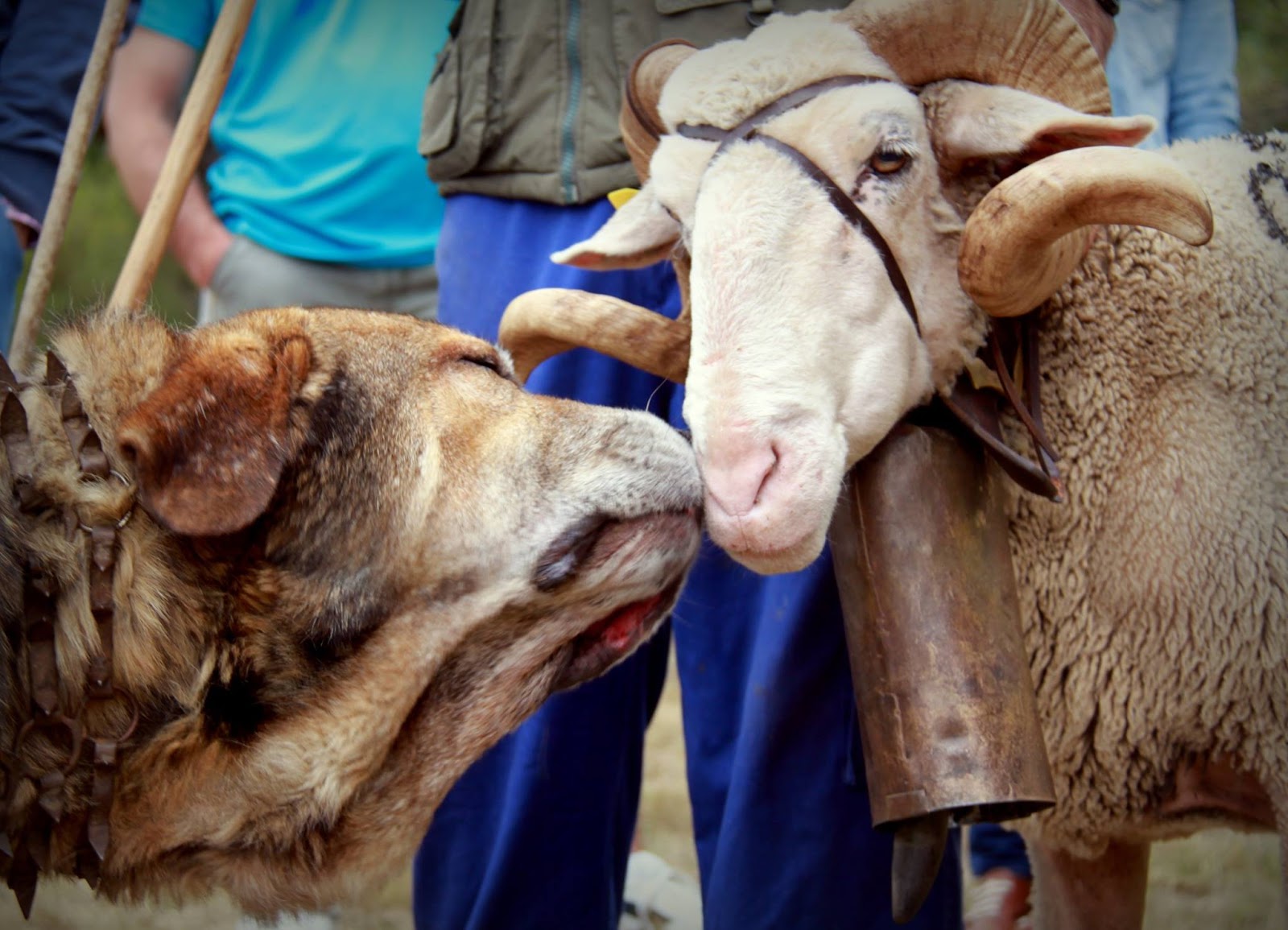
Innate to the Spanish Mastiff, is a grace, a nobility, a presence mere words fail to describe, that must be seen in the flesh to understand.  I sense it most when I am with my Spanish Mastiffs and my sheep and cattle.  The measured gaze of an old soul gazing upon its flocks and sheep, an image of dignity.  Compassionate, magnanimous, never unjust.  To truly take the time to understand in depth this great breed, man must leave his ego at the door.  There is no room for braggart owners, arrogance or petty, small minds in the world of the Mastin.  These giants require respect.  They expect more from their owner than the average dog; they expect you will have the intelligence and the discernment to be able to understand them, and live with them.  They are royalty amongst guardian breeds, and need not prove anything.  The rich history of Spain runs through their veins, the shepherd, the working peon, the eaters of simple bread and cheese, who trek miles with their flocks, sleeping on the ground under stars.  From the poorest shepherd's home has come the greatest of all guardians, and I am honored to share my life with them.  I am humbled by their affection and loyalty, they are like lions, and nothing could be more noble.

Innata para el mastín español, es una gracia, una nobleza, una presencia meras palabras no pueden describir, que debe ser visto en la carne de entender. Tengo la sensación de que la mayoría cuando estoy con mis mastines españoles y mis ovejas y el ganado. La mirada medido de una vieja alma contemplando sus ovejas y ovejas, una imagen de dignidad. Compasivo, generoso, nunca más injusta. Para realmente tomar el tiempo para comprender en profundidad esta gran raza, el hombre tiene que dejar su ego en la puerta. No hay espacio para los propietarios de fanfarrones, la arrogancia o pequeños, pequeñas mentes en el mundo de la Mastin. Estos gigantes exigen respeto. Se esperan más de su dueño que el perro promedio; que esperan que usted tiene la inteligencia y el discernimiento para poder comprenderlas, y vive con ellos. Son Royalty entre las razas de la guarda, y no necesita probar nada. La rica historia de España corre por sus venas, el pastor, el peón de trabajo, los comedores de pan simple y queso, que trek millas con sus rebaños, durmiendo en el suelo bajo las estrellas. Desde la casa del pastor más pobre ha llegado el mayor de todos los guardianes, y me siento honrado de compartir mi vida con ellos. Me siento muy honrado por su afecto y lealtad, son como leones, y nada podría ser más noble.

Photos courtesy of Sociedad Canina de Leon, Ganadaria Fial / Mastines de Abelgas and the author.


Wednesday, June 8, 2016

Foxtails! Protect Your Livestock Guardian Dog from This Summer Scourge


Foxtails! The bane of any stockman's existence in summer.


In parts of Northern America each summer brings the blooming of the dreaded foxtail or diaspore grass.  Grasses known as foxtail include:


This invasive grass sprouts a wheat-like head of faceted seed shafts that resemble the tail of a fox.  As they dry out and mature, they dislodge from the base, and become easily attached to a dog's fur as he passes through them.  Or, if the dog puts his face in a growth of foxtail, they can pierce through eyes or become lodged in an ear canal.  On the ground, they are picked up in a dog's feet and can become imbedded between toes and pierce the skin.  Once in the dog's flesh, if not caught in time they can puncture and travel throughout the dog's body just by entering a part of it's body, whether it be an ear, toe, eye or other area.  Eventually they will emerge, but the pain and discomfort they cause are considerable.  In rare cases foxtails can puncture vital organs and cause death.

Long haired dog breeds are more susceptible to picking up foxtails however, short haired dogs can pick them up too.  Also, the shape of a dog's foot comes to factor in as to if he is prone to picking up foxtails or not.  Experience has shown me even some long haired dogs do not attract foxtails as much if their hair is particularly fine and their feet are set up so that the foxtail spears have a difficult time wedging in between toes.  The only dogs I own here who do not pick up foxtails in their feet are my Spanish Mastiffs.  The space between their toes and shape of their pads seem to deflect them.

Above and below, Spanish Mastiff feet seem to not pick up foxtails due to their structure.  Also note the extremely slick, short hair below on Hermosa's legs and toes.  Foxtails can't grab on to it.


There are a few things you can do to help prevent your dog getting full of foxtails.  Weed control and abatement is of course, of primary concern, but the invasive nature of the foxtail, and the ease by which its seeds are scattered by birds or transported by other animals and humans (for example on clothing or shoes), makes traditional week abatement methods a gallant but often fruitless effort at best.

Having lived in foxtail country on ranches most of my life, I've learned to deal with them by meticulous management of my dogs exposure to them, and time consuming yet necessary daily checks of feet, eyes, ears, and other body areas, in addition to grooming and trimming toe and feet hairs.  I go as far as to close off the back fields where the foxtails are the worst, and keep my dogs out of them for a month.  Once the pesky weeds have peaked out and bloomed, I haul a drag behind my lawn tractor and knock down the dry stands.  Because I don't like to use pesticides and herbicides where my sheep and cattle graze, that type of action is out.  I resort to hand pulling the weeds up and burning them in a fire ring or pit when dry.  On my lawn, spot spraying with herbicide seems to help but then some days I look out there at the clumps of foxtails and just throw my hands in the air in despair!

Aside from stopping the growth of this pesky grass, there's things you can do to help your dogs get through the foxtail season with minimal damage.  As I mentioned above, daily checks are a must.  Examine closely toes and between the toes, female dog's private areas, and legs where longer hair may pick up foxtails.

Regular combing and brushing out can remove many foxtails.  I also can highly recommend kiddie wading pools so your dogs can soak their feet. What does this do? It actually softens the foxtail if it is stuck in your dog's foot and may facilitate its removal or coming out, much faster.


The reliable $9.99 kiddie wading pool from your local Walmart can be a life saver.  It provides a way for your hard working dogs to cool off in the heat of summer and, soak their feet.  The water will soften imbedded foxtails and often aid in their dropping off of the dog's foot or leg.  Here, two of my Spanish Mastiff girls Gwangi and Hermosa take a cool drink and soak their feet.

But what to do if you find foxtails galore in your dog's feet, ears, or coat?  Get a good pair of tweezers, and go to work!  The following photos will include captions describing what to look for, and what a foxtail looks like imbedded in a dog's skin, and once taken out.

Can you see it?  Lodged between the upper toes is a foxtail.  I have just begun trimming the hair around the foot and toes so the foxtail is exposed for easier plucking with tweezers.

A foxtail has just entered between the toes on this dog's foot.  The foot has not been trimmed yet.


This dog's foot has been trimmed, making it easier to find the tiny foxtail imbedded between his toes.

What a trimmed foot looks like after I remove excess hair between and around toes.

Yuck!  The nasty culprit that was on it's way deep into Pinta's paw, and the rest of the shaft which broke up around it once I dug the foxtail out.

Gotta get one - or two or three or more.  When a dog can soak it's feet, it can help remove the foxtails.

The good shepherd or attentive rancher will inspect his dog's feet daily if running them in foxtail country.  A little bit of preventative measures, such as brushing the dog out, trimming toe hair and a wading pool or trough that the dog can get into, can help prevent foxtail infestation.  Daily monitoring will ensure that a foxtail does not cause serious damage.  Foxtails are a pain - but we all can do our best to ensure our dogs do not suffer needless pain!


Tuesday, May 3, 2016

The Way of The Pack: Understanding & Living With Livestock Guardian Dogs


THE WAY OF THE PACK
Understanding & Living With
Livestock Guardian Dogs

© 2017 Brenda M. Negri
All rights reserved

My LGD training, understanding and use book is coming along great with a publisher showing strong interest in it.  I'm excited about the response from people when told this will be a practical, hands on manual for shepherds - no rehashing of breed histories; this won't be another vanity publication detailing someone's grant funded flowery travel tales of exotic locales and stories of "how they do it" some place else.  That is not what American farmers and ranchers ned.  The American LGD owner needs to know how best to use these dogs HERE, in a responsible, compassionate manner that shows respect - NOT mistreatment - of these great dogs.  If you are sick and tired of reading authors talk about and promote cruel shock collar remedies, the use of inhumane "yokes", the promoting of inhumane range whelping by uncaring shepherds of feral LGDs, then this book is for you because it will show you the other side of the coin.  It will focus on more responsible and compassionate ways to own and raise and use these dogs.  This book will hopefully be the one you refer to time and again and instead of being regulated to a bookshelf or coffee table after one read, and you'll keep it handy in the barn for quick reference.


Search This Blog

Popular Posts!